


Recency of Practice Requirements in Australia
02 Nov 2026
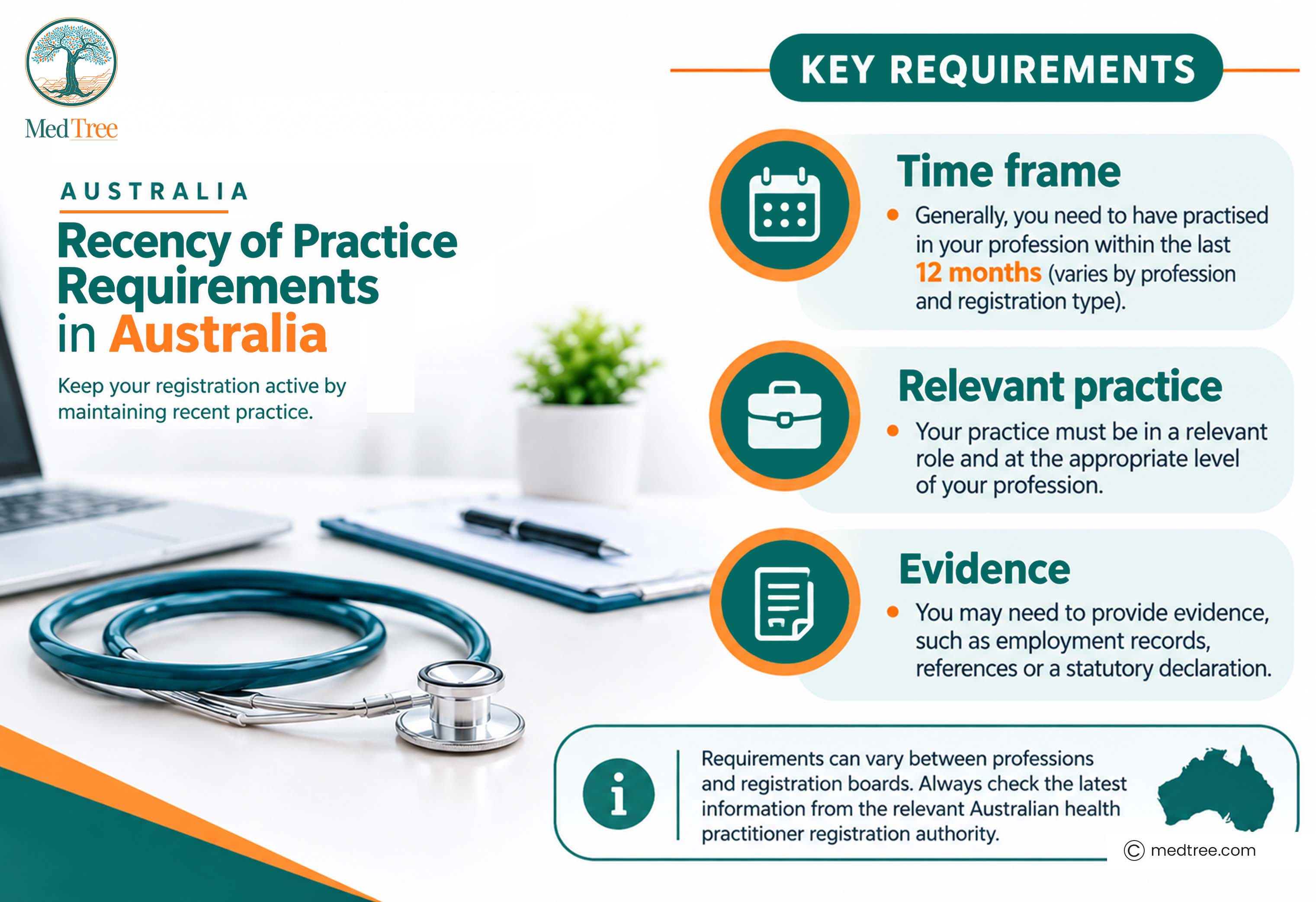
Recency of practice requirements in Australia ensure registered health professionals keep their skills current and updated.
Ahpra (the Australian Health Practitioner Regulation Agency) works with 15 National Boards to register practitioners.
Ahpra works with 15 National Boards to regulate registered health practitioners in Australia. Each National Board establishes registration standards for its profession. Medical practitioners follow the Medical Board of Australia, while nurses and midwives follow the Nursing and Midwifery Board of Australia (NMBA). Other registered health professionals must follow the standards set by their respective National Boards.
Key Takeaways
- Recency of practice in healthcare means recent practice within the scope you intend to work in.
- Doctors currently need 152 hours in one year or 456 hours over three consecutive registration periods.
- Up to 38 hours a week can be counted.
- Clinical work with some non-clinical work, can count if it uses your professional skills.
- Keep employer and roster records.
- If you have a gap, the Board may require conditions, further education, a re-entry plan or supervised practice.
What Does Recency of Practice Mean?
Recency of practice is the amount of recent work a practitioner or any healthcare professional has done in their profession. It supports safe care because skills fade without practical use.
It also links to intended scope of medical practice. A doctor who has worked only in dermatology for years cannot assume that counts towards emergency medicine.
AHPRA Recency of Practice Requirements in Australia
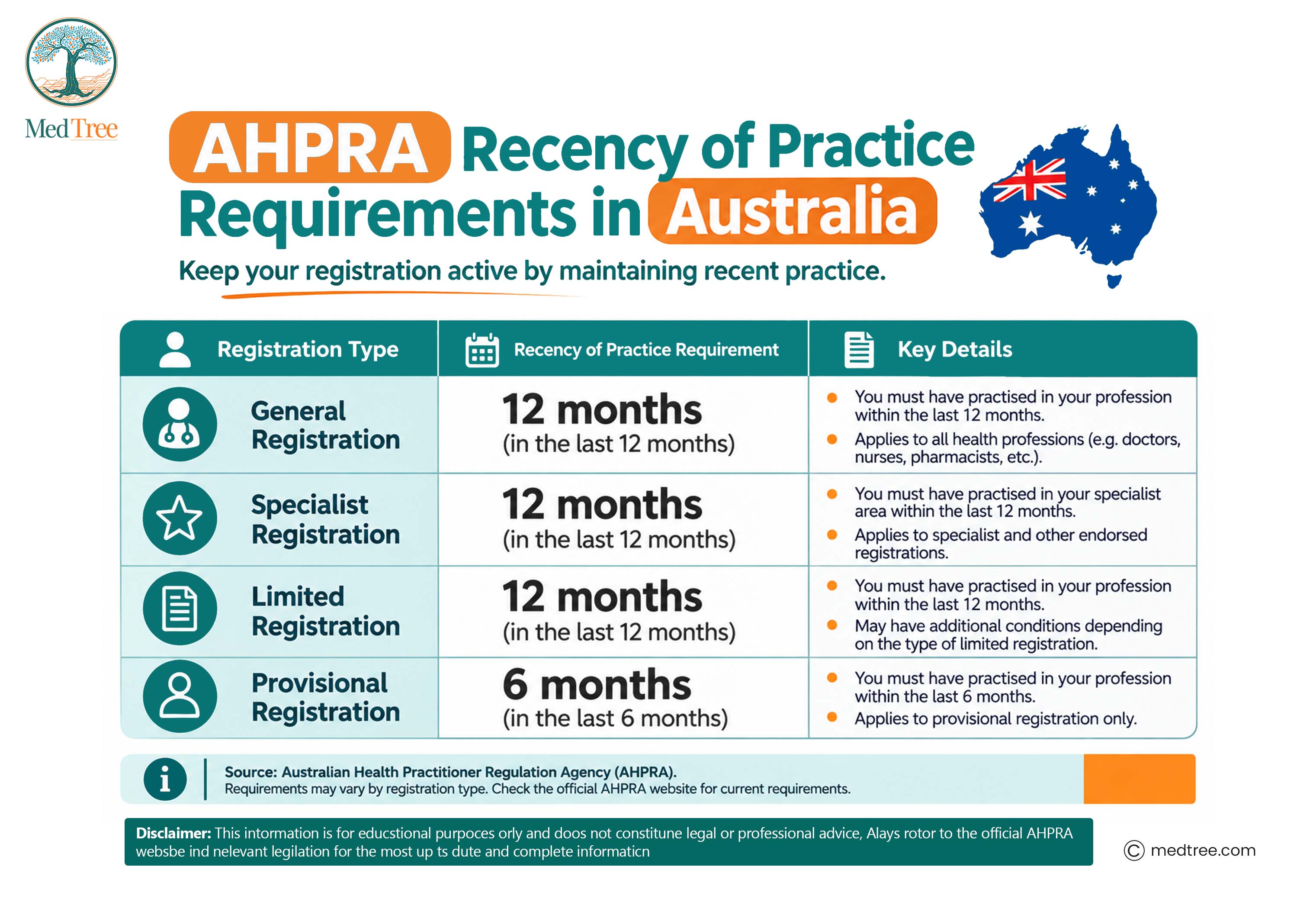
Ahpra supports the National Boards. These Boards set the registration standards. The Medical Board's current standard took effect on 1 October 2016. It applies to all registered doctors except those with non-practising registration.
|
Group |
Standard |
Hours |
Status |
|
Doctors |
Medical Board |
152 in one year, or 456 over three consecutive years; 38 hours a week maximum |
Current |
|
Doctors |
Review consultation (closed 2 March 2026) |
150 or 450; 37.5-hour weekly cap |
Proposal Only |
|
Nurses and Midwives |
NMBA standard (effective 1 June 2016) |
Check the standard |
Current: draft revision consulted on until 17 July 2026 |
The 152 hours equal four weeks full-time equivalent. However, the 456 hours equal 12 weeks. Both rely on a 38-hour week. These requirements connect directly to renewal, because you declare compliance when you renew registration.
What Counts as Recent Professional Practice?
The Board's FAQ makes clear that your hours must fall within your scope of practice. Under the standard, practice is not limited to direct patient care. Where the standard allows it, these can count:
- Clinical work in your scope.
- Teaching, supervision and research.
- Policy, management and other roles that use your medical expertise.
Hours do not need to be consecutive, and part-time work counts too. You do not need a set number of hours each week, but monthly single days fall short.
A few recency of practice examples:
- One 7.6-hour day a week over a 48-week year is enough.
- One 3.5-hour session a fortnight gives about 91 hours, which is not enough.
Recency of Practice for International Medical Graduates
If you are an IMG, check recency before you apply. AHPRA recency of practice for international medical graduates is assessed separately from your AMC pathway and your English-language evidence. Passing one does not satisfy the others.
Keep employer statements, position descriptions and supervision records. Recent work in your intended field, ideally with appropriate supervision, strengthens your IMG AHPRA registration application.
What If You Have a Career Gap?
The Board does not apply one pathway to everyone. Outcomes depend on your experience, your scope and how long you have been away. Here are the options may include for career gap:
- Conditions on registration.
- Extra education or assessment.
- A re-entry plan.
- Supervised practice
Explain the gap clearly, with evidence such as parental leave, illness or overseas work. If you are returning to practice after a gap, contact Ahpra early.
How to Calculate Your Practice Hours?
An example scenario that you can consider:
Dr Lee works eight hours every second Saturday. That is 26 sessions, or 208 hours. This meets the one-year requirement.
A 45-hour week still counts as only 38 hours.
Checklist before renewal:
- Total your hours across the registration period.
- Apply the weekly cap.
- Check the hours fall within your scope.
- Decide whether the one-year or three-year test suits you.
- Gather your evidence.
Documents and Evidence to Keep
Ahpra may ask you to substantiate your declaration. Keep these documents:
- Employer statements and employment records.
- Position descriptions.
- Timesheets and rosters.
- Supervision records.
- CPD records (these show learning, not practice hours).
- Evidence of teaching, research or other activities.
- Letters explaining career gaps.
It is important to note that the above-mentioned requirements can differ between professions.
Do Recency of Practice Requirements Differ for Nurses and Other Healthcare Professionals?
Yes, requirements of recency practice differs for nurses and other healthcare professionals. Each Board sets its own standard. For nursing registration renewal, nurses and midwives follow the Nursing and Midwifery Board of Australia (NMBA) standard. Do not apply the doctors' hours to nursing practice.
The Registered Nurse Standards for Practice and Nursing Standards for Practice documents set expectations for competence. The NMBA's separate nursing recency of practice standard covers recency. Check it when you plan your nurse registration in Australia.
Frequently Asked Questions
What does recency of practice mean?
Recency of practice means that recent work of healthcare professionals (doctors, nurses, midwife, and occupational therapist) must come within the intended scope of practice.
How many hours of practice are required for AHPRA registration?
Hours of practice for AHPRA registeration depends on the profession. However, doctors currently need 152 hours in a year or 456 over three years.
Do doctors need to practise every year?
No, they do not have to practice continuously every year. Medical boards often allow career breaks, provided the doctor maintains their annual continuing education and meets minimum practice hours over a flexible multi-year timeframe.
Can non-clinical work count towards recency of practice?
Most often yes, especially it comes within your scope and meets the standard.
Does part-time professional practice count?
Yes, part-time professional practice count if you reach the total hours.
What happens if a healthcare professional has a career gap?
The Board may impose conditions or require further training, a re-entry plan or supervision.
Can doctors meet practice requirements over three years?
Yes, doctors can meet the requirements with 456 hours across three consecutive registration periods.
Do international medical graduates need to meet recency requirements?
Yes, the standard applies to all registered doctors, apart from non-practising registrants.
Is recency of practice required when professionals renew registration?
Yes, it is important for healthcare professionals to declare recency of practice whenever they renew their registration.
Conclusion
Understanding the recency of practice requirements in Australia is important for maintaining registration and demonstrating professional competence. Doctors should follow the Medical Board of Australia's current practice-hour requirements. However, nurses, midwives and other registered health professionals must follow the standards set by their respective National Boards.
Always keep accurate records of your professional activities. Check for regulatory updates and contact AHPRA or your relevant National Board if you have concerns about a career break or returning to practice.
Disclaimer:
This blog is for general informational purposes only and does not constitute professional, medical, legal or registration advice. AI tools were used to assist in creating the written content and images. Errors or inaccuracies may still occur despite using official sources. Readers should independently verify information with Ahpra and the relevant National Board before making any registration or professional decisions.
References:
- Medical Board of Australia: Recency of Practice FAQs
- Medical Board: Recency of Practice Consultation
- NMBA: Recency of Practice Standard
- Ahpra: Registration Standards
- Australian Medical Council: IMG Pathways