


Nursing Shortage in Australia: Causes, Impact, Statistics & Future Solutions
16 Jul 2026
Ask anyone working a ward floor in Sydney or Perth right now, and they'll tell you the same thing: there aren't enough nurses. It is a structural problem that has been building for over a decade, and the government's own modelling confirms it.
Is there really a shortage of nurses in Australia?
Yes, but the reality is more complex than "not enough people want to be nurses." Australia currently has around 414,000 registered nurses, more than ever before. The workforce is growing. But the problem is that demand is growing faster.
The Department of Health and Aged Care's Nursing Supply and Demand Study projects a national undersupply of roughly 70,700 full-time equivalent nurses by 2035. Because many nurses work part-time, that translates to closer to 79,000 individual nurses needed to close the gap. This is Australia's most rigorous, government-commissioned projection, and it's the figure most workforce bodies now cite.
Why Is Australia Facing a Nursing Shortage?
Australia's nursing shortage is the result of several long-term workforce challenges rather than a single issue. An ageing population, increasing demand for healthcare services, workforce burnout, early retirements, and difficulties recruiting and retaining nurses have all contributed to the current shortage.
Causes of the Nursing Shortage
An Ageing population is driving demand up
Older Australians need more frequent and more complex care. They need care regarding chronic disease management, multiple medications, and longer hospital stays. Every year, the population ages further, healthcare demand increases, and the number of nurses required to meet that demand rises with it. This is not a sudden demand; it is a permanent shift in the type of care the system needs to deliver.
Nurses are leaving faster than they're being replaced
Entry rates into the profession sit around 12 to 13% annually, only just ahead of exit rates of 10 to 11%. This margin sounds okay on paper, but it is not enough to fulfil rising demand. Burnout is the biggest driver of exits. Heavy patient loads, understaffed shifts, and rising incidents of workplace violence (around 10% of nurses report having been assaulted on the job) are pushing experienced staff out the door, sometimes years before retirement age.
The training pipeline takes years to fill
Becoming a registered nurse takes a minimum of three years of study, plus supervised transition-to-practice placements. When shortages hit, the healthcare system can not respond quickly. It takes half a decade or more for policy changes to translate into extra staff on the floor.
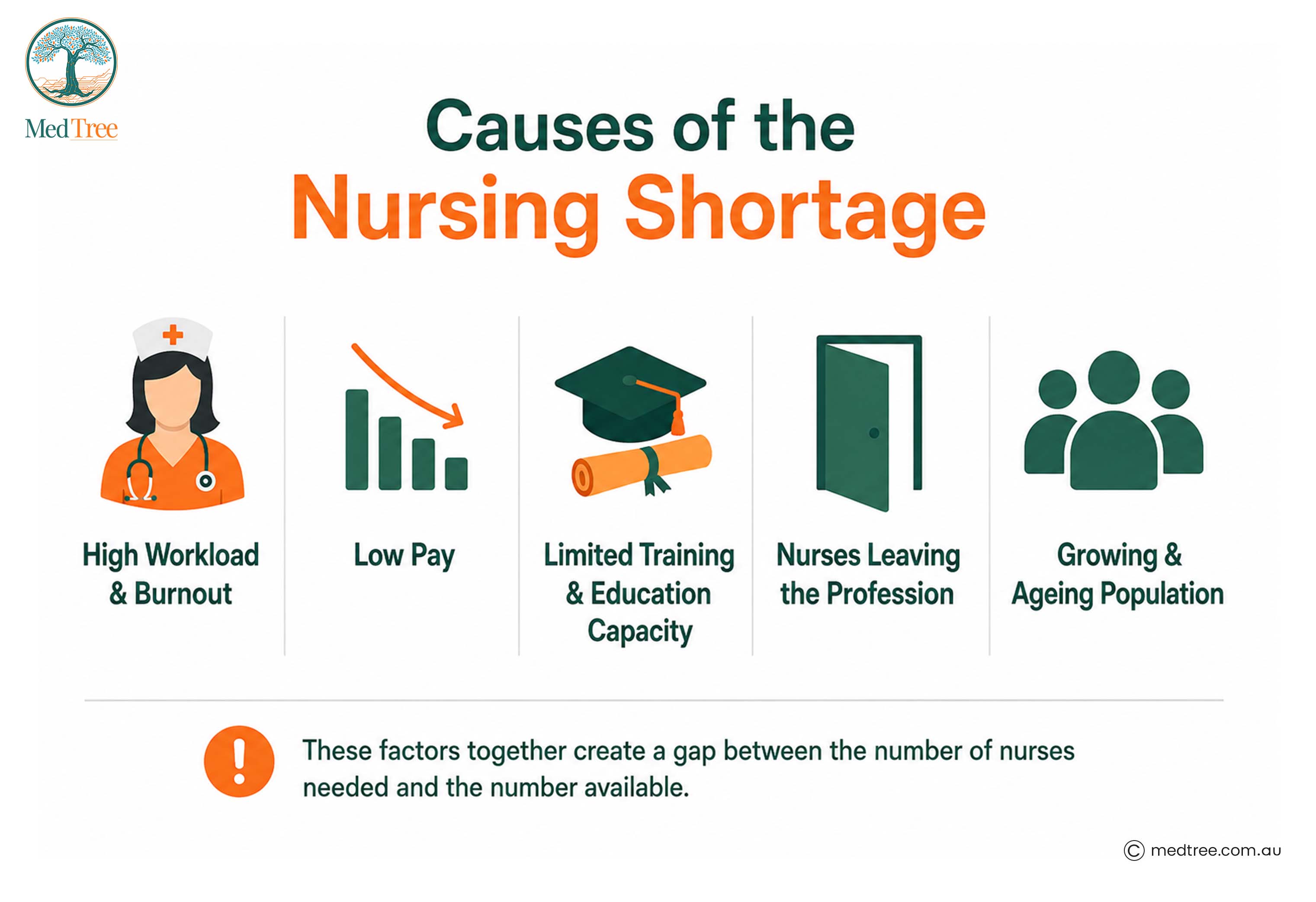
Maternity leave and part-time work reduce effective supply. About 88% of Australia's nurses are women, and many either don't return to the profession after having children or return only in a part-time capacity. This reduces the total available working hours even as headcount grows.
Here's how these causes chain together into a worsening cycle:
|
Stage |
What Happens |
|
Rising demand for healthcare |
Australia's ageing population and increasing rates of chronic disease lead to greater demand for healthcare services. |
|
Fewer nurses per patient |
The available nursing workforce cannot keep up with the growing number of patients, resulting in staffing shortages |
|
Heavier workloads |
Nurses care for more patients, work longer shifts, and have less time to provide quality care. |
|
Burnout and moral distress |
Excessive workloads contribute to physical exhaustion, emotional fatigue, and stress. |
|
Higher resignation and early retirement rates |
Some nurses reduce their hours, leave the profession, or retire earlier than planned. |
|
Smaller workforce |
The loss of experienced nurses further reduces the available workforce. |
|
The cycle repeats |
With fewer nurses available, workloads continue to increase, making the shortage even more severe. |
Statistics: the current state of the workforce
- 414,000 registered nurses are currently practising in Australia, the largest single health profession in the country.
- 70,707 FTE projected national undersupply of nurses by 2035, according to the Department of Health and Aged Care.
- ~79,000 individual nurses are needed to close that gap, once part-time work patterns are accounted for.
- 9,088 FTE projected a shortfall specifically among First Nations nurses by 2035.
- 16,622 internationally qualified nurses were added to the Australian register in a single recent year through streamlined AHPRA processing.
- 12 to 13% annual entry rate into the profession, against 10 to 11% annual exit rates.
- ~10% of nurses report having experienced workplace assault.
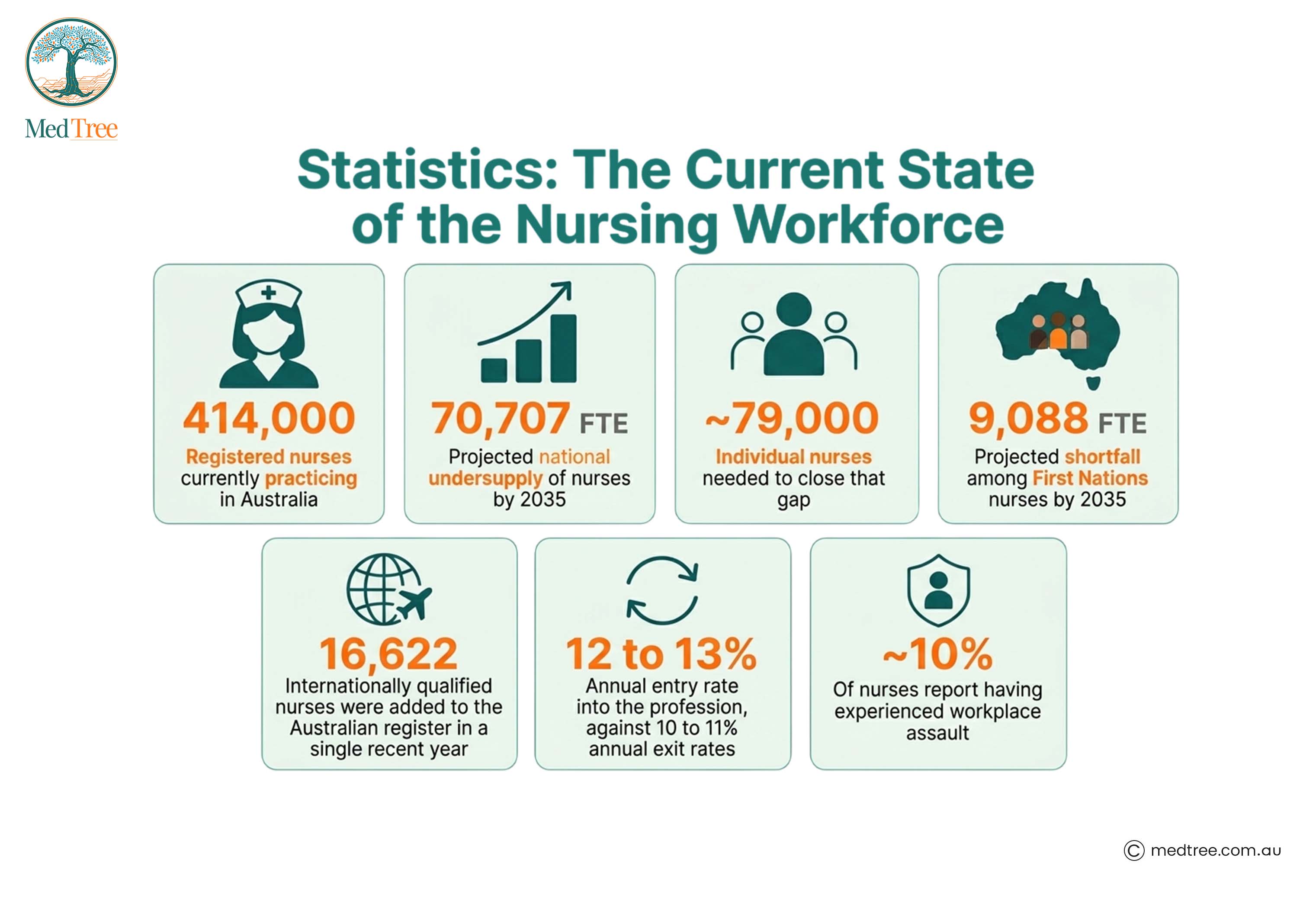
These numbers matter because they show a workforce that is growing in absolute terms but still losing ground relative to healthcare demand. A larger headcount alone won't fix the shortage if exit rates, part-time patterns, and demand growth are not addressed seriously.
Shortfall by sector, projected to 2035
|
Sector |
Projected FTE shortfall |
|
Acute care (hospitals) |
~26,700 |
|
Primary healthcare |
~21,800 |
|
Aged care |
~17,600 |
|
First Nations nursing workforce |
~9,100 |
Acute care bears the brunt because it's where patient complexity is highest and rostering flexibility is lowest. Aged care faces its own pressure. Since 1 July 2023, most residential aged care homes have been required to have a registered nurse on site 24/7. From 1 October 2024, providers have also been required to deliver an average of 215 care minutes per resident per day, increasing demand for an already stretched nursing workforce. That's a good outcome for residents, but it has tightened an already stretched labour pool.
Which Australian States Have the Biggest Nursing Shortages?
Here is the complete breakdown of the state-wise shortage of nurses in Australia.
|
State |
Current Situation |
|
NSW |
High demand in hospitals and regional areas |
|
Victoria |
Growing workforce demand due to population growth |
|
Queensland |
Significant shortages in regional communities |
|
WA |
Difficulty recruiting rural nurses |
|
SA |
Increasing aged-care demand |
|
Tasmania |
Small workforce with an ageing population |
Impact of the Nursing Shortage
Impact on Patients
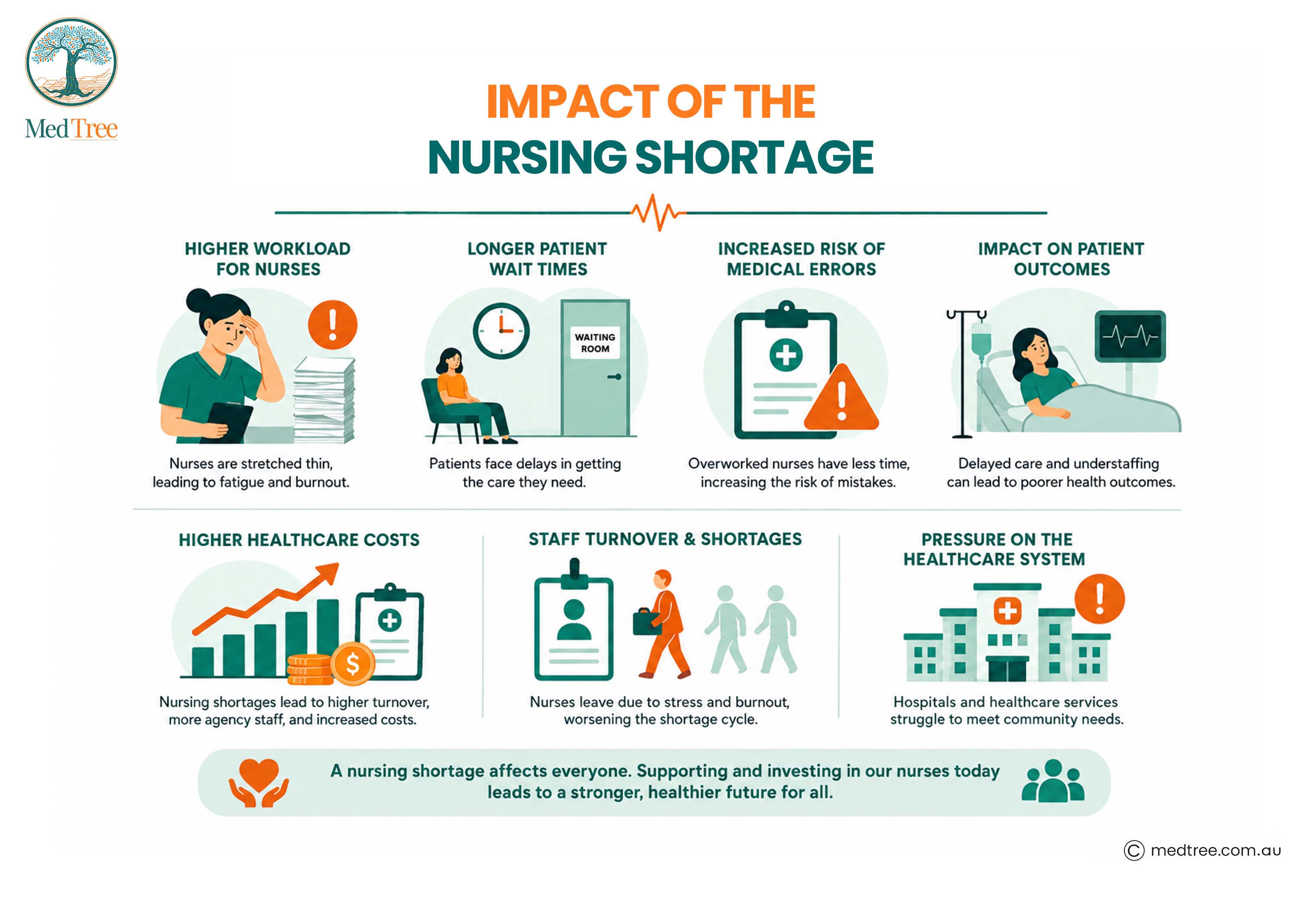
Understaffing doesn't just mean nurses are tired. It shows up in outcomes. Research consistently links high nurse workloads to more medication errors, more missed or delayed care, longer emergency wait times, and higher rates of preventable hospital readmission.
Impact on nurses
Remaining staff absorb the workload of unfilled positions, which accelerates burnout and pushes more people toward resignation or early retirement. Hence, it deepens the shortage further.
Impact on hospitals and healthcare services
Hospitals lean more heavily on expensive agency and overtime staffing just to keep wards safely covered, diverting money that would otherwise fund permanent positions or frontline services. Rural and regional Australia, home to roughly a quarter of the population, carries a disproportionate share of the pain. Moreover, fewer nurses are willing to relocate away from major cities, so remote hospitals often run with skeleton crews and heavier reliance on locum staff.
Economic impact
Chronic reliance on agency staffing, combined with overtime costs and recruitment delays, adds significant ongoing expense to a health system already under budget pressure. In aged care specifically, recruitment delays for registered nurse positions have stretched to eight to ten weeks in some markets, which is a direct cost in both money and care continuity.
Future solutions to the nursing shortage
Government and professional bodies aren't standing still.
- Faster international recruitment. Streamlined AHPRA registration pathways have already added over 16,000 internationally qualified nurses to the register in a single year. Nursing remains on the national Skills Priority migration list, with faster visa processing for qualified applicants.
- Expanded scope of practice. The Australian College of Nursing's 2026 to 27 federal budget submission pushes for wider registered nurse prescribing rights and nurse-led primary care models, so existing nurses can do more without waiting years for new graduates to fill gaps.
- Retention investment. Proposals include transition programs, retirement support, and funding to prevent experienced nurses from leaving early, alongside safer staffing ratios and stronger protections against workplace violence.
- Education and training expansion. Continued growth in nursing course completions (over 19,000 in 2025) needs to be matched with funded graduate positions and clearer pathways back into practice for nurses with lapsed registration.
Can the shortage be fixed?
Realistically, no single measure closes a 70,000-nurse gap on its own. But a combination of faster international recruitment, better retention, expanded scope of practice, and sustained investment in nursing education can bend the curve. The system won't return to abundance overnight, but the trajectory isn't fixed either.
Frequently Asked Questions
Is there a shortage of nurses in Australia?
Yes, currently Australia is facing a growing yet severe shortage of nurses. Official government modelling projects a shortfall of roughly 70,000 full-time equivalent nurses by 2035.
Why are nurses leaving Australia's workforce?
The reasons behind Australia’s workforce include burnout from heavy workloads, workplace violence, and insufficient staffing ratios.
Which state of Australia has the biggest nursing shortage?
New South Wales, Queensland and Victoria are facing the biggest nursing shortage. These states carry the largest raw numbers, but rural and regional areas nationwide face the most severe access gaps.
Will Australia need more nurses in the future?
Yes. Australia needs more nurses as demand is projected to keep outpacing supply through at least 2035, driven mainly by population ageing.
Can international nurses work in Australia?
Yes. Streamlined AHPRA registration and priority migration pathways make Australia increasingly accessible to overseas-qualified nurses.
How is the government addressing the shortage?
The Australian government is addressing this issue through faster registration processing, migration incentives, scope-of-practice expansion, and targeted budget investment in retention and training.
Conclusion
Australia's nursing shortage is a long-term structural challenge. The causes are well understood, the statistics are sobering, and the impact is already visible in hospitals, aged care facilities, and rural communities across the country. What happens next depends on whether recruitment, retention, and scope-of-practice reforms can outpace a population that keeps ageing and a workforce that keeps stretching thinner. The tools to close the gap exist; the open question is how quickly and consistently they get used.
This blog is for informational purposes only. While every effort has been made to ensure accuracy, workforce data, policies, and statistics may change over time. Always refer to official Australian government and regulatory sources for the latest information.
References
- Australian Government Department of Health and Aged Care. Nursing Supply and Demand Study (2024–2035).
- Australian Institute of Health and Welfare (AIHW). Nursing and Midwifery Workforce.
- Australian Health Practitioner Regulation Agency (AHPRA). Registration Data.
- Australian Government Department of Health and Aged Care. Aged Care Reforms.
- Australian College of Nursing (ACN). Federal Budget Submission 2026–27.