


Nurse Practitioner in Australia: Salary, Duties & How to Become a Nurse Practitioner
16 Oct 2026
What is a nurse practitioner in Australia?
A nurse practitioner is a nurse with advanced nursing education, extensive clinical experience (at least 5,000 hours), and registered with the Nursing and Midwifery Board of Australia (NMBA).
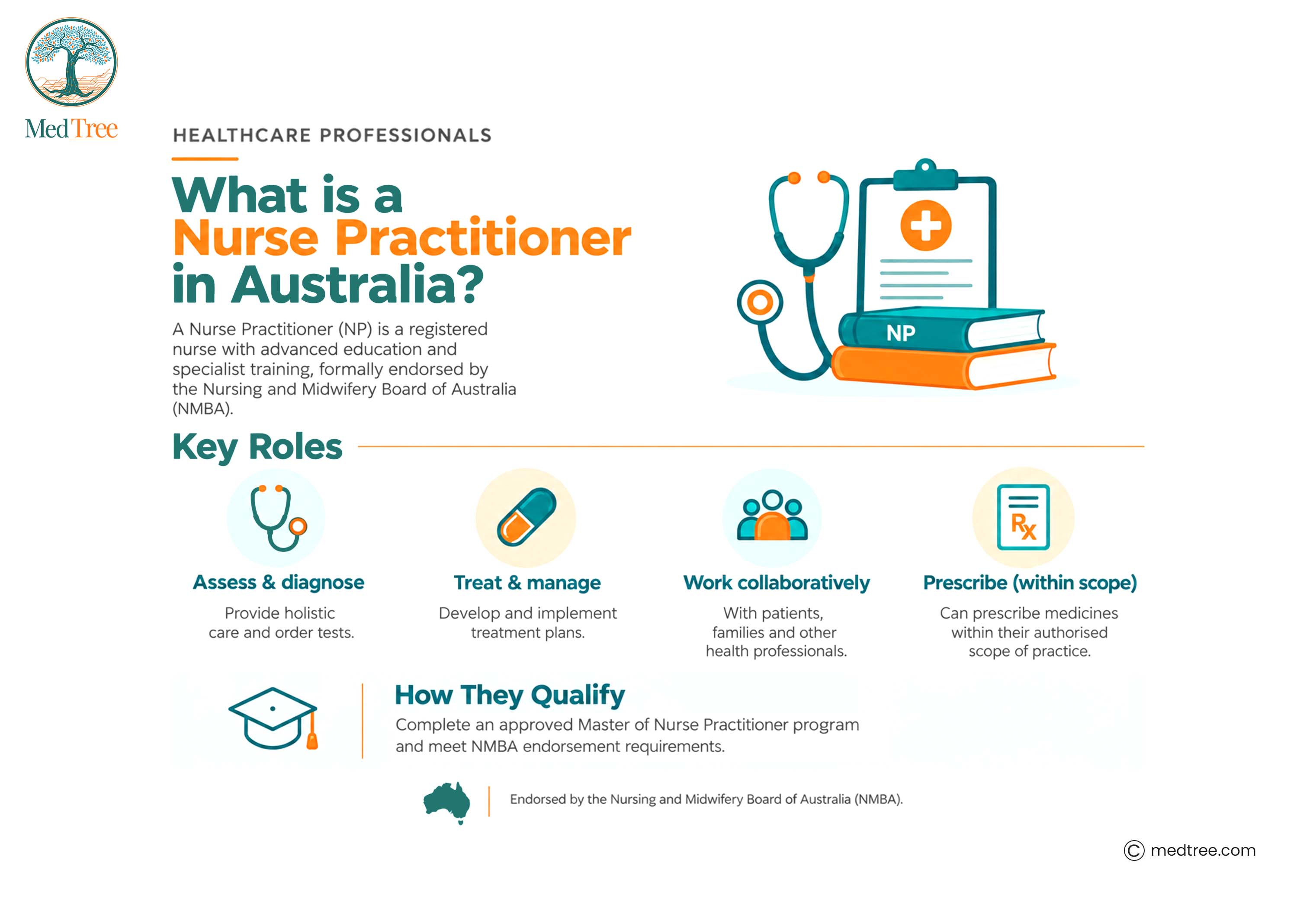
“Nurse practitioner” is a legally protected title that only endorsed nurses can use.
A nurse practitioner can perform multiple tasks, including:
- Assess patients
- Diagnose conditions
- Order and interpret tests
- Prescribe medicines within their authorised scope
- Manage treatment plans
- Refer patients to other health practitioners
If you are thinking of becoming a nurse practitioner. Here is what you need to do.
- First, you need to register as a nurse
- Build 5,000 hours of advanced practice
- Complete an approved master's degree
After completing the requirements, you can apply for endorsement through AHPRA.
|
Quick Facts |
Summary |
|
Salary (estimate) |
Roughly $100,000 to $170,000 a year, depending on employer, award and location (see salary table) |
|
Education and Preparation |
Nursing degree, at least 5,000 hours of advanced practice, then an approved master's. Total time varies by person |
|
Key Eligibility |
Current registered nurse registration, 5,000 hours of advanced practice in the past six years, NMBA-approved master's, and the Nurse Practitioner Standards for Practice |
|
Regulator |
NMBA, with application handled through AHPRA |
These Salary figures are estimates from the sources listed below and can vary. Always check them before making career decisions.
What is the difference between Registration, endorsement and AHPRA?
- Registration lets you work as a registered nurse.
- Endorsement is an extra recognition on that registration. It shows you meet the nurse practitioner standard.
- AHPRA is the agency that runs the application process for the NMBA.
Nurse practitioner vs registered nurse in Australia
One question that often comes to mind is: What's the difference between a nurse and a nurse practitioner?
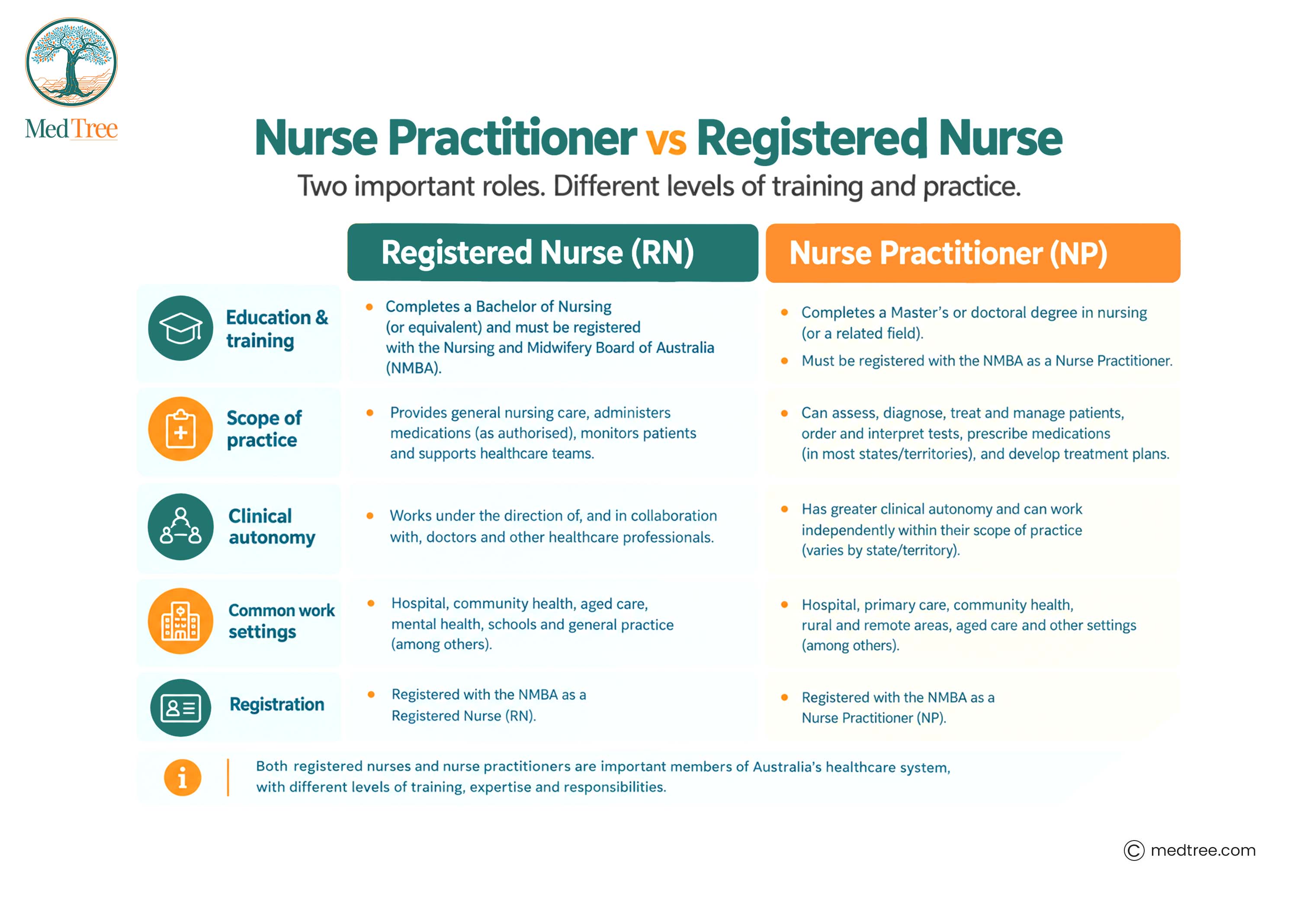
Both are nurses, but experience and practice make a difference. A nurse practitioner has extra training, experience and legal authority.
|
Registered Nurse |
Nurse Practitioner |
|
|
Registeration |
General registration with NMBA |
Registered Nurse registration plus NMBA endorsement |
|
Education and Experience |
Bachelor's degree in nursing (or an approved equivalent) |
Registered nurse pathway, 5,000 hours of advanced practice and an NMBA-approved master's |
|
Clinical Autonomy |
Works within a care team and their employer’s policies |
Practises at an advanced level with more independent decision-making |
|
Prescribing |
Registered nurses generally cannot prescribe independently unless they hold a relevant prescribing authorisation. Eligible designated RN prescribers can prescribe specified medicines under applicable legislation, a prescribing agreement and clinical governance arrangements. |
Can prescribe medicines within their authorised scope of practice and applicable state or territory laws. |
|
Typical Duties |
Care delivery, education, monitoring and coordination vary by role |
Assessment, Diagnosis, Tests, Treatment plans, prescribing and referrals |
|
Salary Potential |
Varies by award and experience |
Generally higher, but depends on employer |
|
Career Pathway |
Clinical, leadership, education and specialty role |
Advanced clinical practice, often in a specialty area |
Australia introduced a separate endorsement for designated registered nurse prescribers in 2025. This allows eligible registered nurses to prescribe specified medicines under applicable legal requirements and clinical governance arrangements.
It is different from nurse practitioner endorsement and does not replace the advanced practice experience, approved education and endorsement requirements for becoming a nurse practitioner.
What does a nurse practitioner do?
Nurse practitioner responsibilities and duties in Australia depend on the clinical setting. However, the common duties include:
- Advanced assessment includes taking detailed histories and examining patients.
- Diagnosis and decision-making means working out what is wrong and choosing a treatment plan.
- Medical tests, such as ordering and interpreting pathology, imaging and other investigations.
- Prescribing, such as starting and adjusting medicines within their scope.
- Referrals and care coordination, such as linking patients with specialists, allied health and community services.
- Education and follow-up means helping patients prevent illness and manage long-term conditions.
Why nurse practitioners are important
Nurse practitioners matter because they improve access to healthcare. It is not wrong to say that they are the backbone of the Australian healthcare system.
By improving access, they can ease pressure on emergency departments and GP clinics. They also help patients in rural and remote areas, where doctors may be hard to find. Many work in primary care, aged care, mental health, palliative care, emergency care and community health.
Nurse practitioner salary in Australia
Nurse practitioner salary in Australia figures vary a lot between sources. Recruitment sites estimate pay from job ads or user reports. They are not guaranteed salaries.
|
Source |
Figure(AUD) |
What it means |
|
Indeed Australia (Retrieved October 2026) |
Average $137,085 a year |
It is an average salary according to the Indeed site. It does not state whether super is included, so treat it as a base estimate |
|
Randstand (Published late 2025) |
$145,000 to $155,000 advertised |
Advertised range. Rural, remote or locum roles can pay more |
|
SalaryExpert (Updated 26 August 2026) |
Average gross $154,129 |
Modelled estimate, not an award rate |
|
Nurses Award Minimum (Reported by Cover 2026) |
From about $100,500 |
Minimum for a nurse practitioner in the second year or later. Many employers pay above this |
|
NSW public health award (reported by wage calculator 2026) |
About $158,237 to $169,429 |
Third-party summary of public-sector rates. Confirm with the current award |
Nurse practitioner salary depends on these factors:
- Location: rural and remote roles often pay more or add allowances.
- Experience and specialty: pay may rise with years of service.
- Employer: public hospitals, private services and private practice differ.
- Agreement: awards and enterprise agreements set pay steps.
- Hours and contract type: part-time, casual and locum work are paid differently.
Always check whether an advertised figure is base salary or a package that includes superannuation.
How to become a nurse practitioner in Australia?
To become a nurse practitioner, you must follow these steps. Requirements include the NMBA's endorsement standard, which the NMBA lists as in effect from 1 June 2016 and pending review. Always check for updates and confirm on the official websites before you start.
- First, meet the requirements for registered nurse registration. Complete an approved nursing qualification and register with the NMBA through AHPRA.
- Second, gain clinical experience. Build experience in the specialty where you want to practise as a nurse practitioner.
- Third, work at an advanced practice level. You need 5,000 hours of advanced clinical practice (see below).
- Fourth, complete an eligible master's degree. It must be an NMBA-approved program leading to endorsement, or one the NMBA judges to be substantially equivalent.
- Fifth, apply for endorsement. Show AHPRA and the NMBA that you meet the standard and the Nurse Practitioner Standards for Practice.
The 5,000-hour requirement
The NMBA requires at least 5,000 hours of clinically based advanced practice in the past six years. That is about three years of full-time work. The practice must involve direct clinical contact.
Advanced practice is judged by the level of your work, not your job title or pay. It involves complex decision-making, autonomous practice and clinical leadership. Ordinary registered nurse hours may not count. Keep records and ask your university how to document your hours.
Universities also set their own entry rules. For example, some require a minimum of 300 hours of supervised practice during the course, plus employer support. It is good if you confirm the 5,000-hour requirement with AHPRA and your university.
Choosing a master's degree
Do not assume every course called Master of Nurse Practitioner Australia meets the standard. Check that the program appears on the NMBA's list of approved programs. Also confirm that the course is accredited by the Australian Nursing and Midwifery Accreditation Council (ANMAC).
Completing the degree does not automatically make you a nurse practitioner. You must still apply for endorsement.
International nurses
International nurses must first register as a registered nurse with AHPRA. The Australian College of Nurse Practitioners says most overseas nurse practitioner qualifications do not transfer directly. Applicants may need an NMBA assessment of whether their program is substantially equivalent. Must read the AHPRA overseas practitioner guidance before applying.
Frequently asked questions
Can you see a nurse practitioner for primary care?
Yes, many nurse practitioners work in general practice, community clinics and aged care. They can assess, diagnose and treat many common and long-term conditions, and refer you when needed.
Are nurse practitioners allied health professionals?
No, not in the usual sense. A nurse practitioner is a registered nurse regulated by the NMBA. Nursing is a separate profession from allied health. Some funding schemes group professions differently, so check the rules that apply to you.
How long does it take to become a nurse practitioner?
There is no exact answer to this. But after a nursing degree, you need around three years of full-time advanced practice (5,000 hours), plus the master's. Also, Part-time study and work can stretch this. Many people take six to eight years in total, but this is an estimate, not an official figure.
Can nurse practitioners prescribe medicines in Australia?
Yes, within their endorsement, scope of practice and state or territory laws. They do not have unlimited prescribing authority.
Is becoming a nurse practitioner worth it?
Yes, it is worth it for many nurses to become a nurse practitioner. This role offers greater autonomy, higher pay potential and advanced clinical work. However, the path is demanding. Because it takes years of experience, study, and often balancing work with a master's. Talk with practising nurse practitioners before you commit.
Final Remarks
A nurse practitioner in Australia is an advanced practice nurse who assesses, diagnoses, prescribes and coordinates care. Their salary estimates start from about $100,000 to over $150,000, depending on the source and employer. The main entry requirements are registered nurse registration, 5,000 hours of advanced practice and an approved master's degree, followed by NMBA endorsement. Before you enrol, check your eligibility with AHPRA, the NMBA and your chosen university.
Disclaimer: This blog was AI-generated and reviewed and edited by a human. AI tools were also used to create relevant images. Despite review, errors, omissions or outdated information may occur. Verify professional requirements, qualifications and salary information with current official sources. AI-generated images are illustrative and may not depict real people or settings.
References
- NMBA, Endorsement as a nurse practitioner (registration standards and guidelines)
- NMBA, Fact sheet: Advanced nursing practice and specialty areas
- Ahpra, Fact sheet: Nurse practitioner standards for practice
- ANMJ, Advance copy of RN prescribing standard released
- ANMAC, Registered nurse prescribing begins
- Australian College of Nurse Practitioners, Become a NP:
- ACNP, Contact form and FAQs (RN prescribing, international NPs, placement hours)
- Monash University, Master of Nurse Practitioner FAQs
- Monash University, Evidence of advanced practice hours
- Indeed Australia, Nurse practitioner salary
- Randstad Australia, How to become a nurse practitioner
- SalaryExpert, Nurse practitioner salary in Australia
- Upcover, Nurse salary Australia 2026
- Wage Calculator, NSW nurse salary and pay rates